
A Complete Guide: What a Fractional CFO Does and Why Businesses Hire Them
A fractional CFO is a seasoned financial leader you can bring in on a part-time, project-based, or retainer basis, without hiring a full time CFO. They help with everything from setting up cash flow forecasts and managing budgets to preparing your business for fundraising, all on a flexible schedule.
Beyond just saving costs, a fractional CFO brings structure, financial visibility, and decision-making support, especially when you’re scaling, preparing for due diligence, or working toward a funding round.
In this article, you’ll get a clear idea of what fractional CFOs actually do, how to know if your business is ready for one, and what to look for if you decide to hire one.
What Does a Fractional CFO Do?
What they do depends entirely on where your business is and what’s broken or missing. But in most cases, their work revolves around systemizing financial processes, simplifying where money moves, where it leaks, and how fast the company can grow.
In recent years, their role has also expanded. Fractional CFOs now take on much more than they once did, adapting to how financial leadership itself is changing.
Strategic Financial Leadership
The first thing a fractional CFO typically does is build tools for strategic decision-making. Raw data alone leads nowhere, so they start by developing a three-statement financial model.
This model analyzes business performance using three core financial statements:
- Income Statement
- Balance Sheet
- Cash Flow Statement
With this structure in place, your business can simulate growth scenarios, perform valuation analysis, and assess investment risk more confidently.
Consider how a company leveraged structured financial planning to their advantage. Their fractional CFO built a bottom-up, three-statement model, streamlined the FP&A process, and prepared investor-ready materials. This clean financial foundation helped them successfully raise $17 million in Series A funding from a VC Fund.
But modeling is just the beginning. A fractional CFO also conducts in-depth risk assessments, identifies financial vulnerabilities, and implements both controls and contingency plans to strengthen the business.
Fractional CFOs Ties Everything Together
Traditional finance roles have evolved far beyond accounting and bookkeeping. Today’s CFOs are increasingly involved in digitalizing the business, introducing automation, and reducing risks created by outdated, manual processes.
According to McKinsey, CFOs have become central to multiple areas of business strategy in recent years and their influence continues to grow.
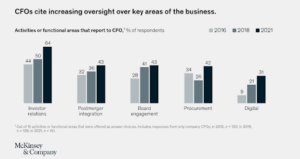
Source: McKinsey
In most growing businesses, operations tend to run in fragments. Data is often scattered across departments and systems, making it difficult to get a clear view of the company’s actual financial position.
This is where a fractional CFO steps in. They unify disconnected systems and help create visibility into your cash position, margin trends, and burn rate—without relying on siloed reporting.
They also assist in integrating tools like NetSuite, Power BI, or Tableau to centralize financial data and surface the metrics that truly matter:
- Gross margin by segment
- CAC/LTV ratios
- Burn rate and cash runway
Cash Flow and Cost Control
Cash runway isn’t optional—it defines how long your business can operate before running out of funds. It shows what’s driving your burn rate, and where financial inefficiencies lie.
A fractional CFO doesn’t overlook this. It’s one of the first things they address.
However, many SMBs mistakenly believe cash control is just about cutting costs or reducing expenses. What they often miss is that cash control is about structure, not just frugality. It means:
- Separating fixed costs from variable costs
- Breaking down unit margins
- Analyzing profitability at a customer or SKU level
Take this example: An oil services business company, uncovered over ₹6.6 crore in immediate cash recovery through tax refunds/credits and internal process adjustments and this was achieved within just three weeks of bringing in a fractional CFO.
In many cases, central and state-level tax credits remain buried in operations. Companies often miss them entirely. Unlocking these requires forensic-level cash flow work, the kind that growing businesses typically don’t have in-house, unless they bring in a fractional CFO.
Fundraising
Investor relations have grown significantly since 2016 and continue to accelerate, according to McKinsey.
Fundraising is one of the most common reasons companies bring in a fractional CFO. Businesses have a need, they want to raise capital and they turn to a CFO to help get the financial story right, often starting with a polished, investor-ready pitch deck.
Fractional CFOs are frequently seen as translators between founders and investors. They speak both the strategic and financial language, making it easier to align expectations, defend projections, and handle diligence.
Especially in Series A or B rounds, fractional CFOs often build a company’s first long-range financial plan, including:
- Cash requirements
- Runway extension strategies
- Equity vs. debt modeling
- Sensitivity analysis
If a round is already in motion, they may lead term sheet review, run negotiation scenarios, and support investor prep. If not, they help shape timing and capital strategy so you can raise with leverage.
What a Fractional CFO Is Not
A fractional CFO is not a catch-all finance assistant. Nor are they a temporary controller filling short-term gaps in your accounting team.
Yes, they may assist with managing finances, investor relations, hiring, and oversight of the finance function, but they are not:
1. Not a Bookkeeper or FP&A Specialist
Bookkeeping and transactional accounting are foundational, but they’re not strategic finance. A fractional CFO doesn’t handle data entry or reconciliations. Their role is to design the financial system, not operate it.
They’re also not your junior FP&A analyst building reports in Excel. Their focus is on decision-making, financial structure, and cross-functional alignment, not day-to-day reporting.
As one finance professional on Reddit pointed out:
“CFO services without accounting is tough….advisory only roles are not in demand unless you have already built the backbone”
2. Not a Quick Fix for Internal Controls
Fractional CFOs aren’t brought in to apply surface-level patches to broken systems or fix under-resourced teams with temporary duct tape.
Instead, they bring decades of experience to re-architect internal controls, build lasting financial infrastructure, and align systems across departments. Their goal is not to fix and leave, but to enable long-term stability and accountability.
In summary, a fractional CFO is not:
- A bookkeeper or junior FP&A assistant
- A controller filling a deficit
- A one-time consultant
- A temporary interim CFO
Why Growing Businesses Choose Fractional CFOs
The value a fractional CFO brings to a growing business can’t be boxed into a single benefit. Their role extends far beyond just financial reporting.
Whether it’s:
- Getting senior-level expertise at a fraction of the full-time cost
- Preparing your business for external funding
- Correcting common scaling mistakes like over-hiring, mispricing, or entering unstable markets
- Or mentoring your in-house finance team at every stage
Fractional CFOs often become the financial backbone for growth-stage businesses — particularly those operating in SaaS or other capital-sensitive models.
Here are a few key reasons why businesses choose to bring them in:
Budget-Friendly Senior Expertise
Not every business can afford a full-time CFO. A seasoned CFO typically comes with 15–20 years of experience, someone who has seen market cycles, worked across both startups and large enterprises, and handled complex financial decisions.
According to salary reports, a senior Chief Financial Officer in India can cost anywhere between ₹1 crore to ₹1.3 crore per year, excluding ESOPs and performance bonuses, especially in funded startups. That’s a significant investment for a business still working to stabilize revenue.

Annual compensation for a chief financial officer in India according to salary report
Fractional CFOs, by contrast, work on flexible structures, but offer the same strategic depth as an in-house executive. Many work 10 to 15 hours per week or take on rolling quarterly engagements.
According to Venture First, fractional CFO arrangements in mature markets typically cost 60% less than full-time roles. That translates to approximately ₹20 to ₹35 lakh per year for high-quality financial leadership.
This affordability is often the biggest reason businesses choose to start with a fractional CFO and then decide later whether an in-house hire is even necessary.
Cross-Functional Vantage
Indian startups are increasingly adopting hybrid business models, combining B2B sales, subscriptions, logistics, and platform-based revenue. These models demand a nuanced understanding of cost structures and growth levers across multiple verticals.
Fractional CFOs bring experience from working across sectors, from SaaS and D2C to healthcare and manufacturing. Many have already:
- Set up ERP and financial reporting systems
- Handled complex reconciliations and foreign fund inflows
- Guided founders through exits, down rounds, or turnarounds
This kind of cross-functional exposure is rare in an in-house CFO who’s only worked within a single company’s framework.
A Trusted External Voice
As businesses grow, they also develop blind spots.
Founders may resist changing pricing models. Teams may avoid revisiting vendor contracts. Finance and ops may not talk to each other often enough. That’s where a fractional CFO brings value as an outside voice—one who isn’t tied to internal dynamics, yet senior enough to ask uncomfortable questions.
When Should You Hire One?
When you bring in a fractional CFO often determines what they can actually do for your business.
Many companies hire one at their pre-seed stage, where the CFO acts more as a strategic advisor. At that point, they help set up systems, build financial models, and ensure compliance is in place early on.
Others bring in a fractional CFO while bootstrapping. In that case, the focus shifts toward cash efficiency and improving revenue generation, making every rupee count.
So, when should you hire a fractional CFO?
- Stage-Based Approach: Look at where your business is right now. Whether you’re bootstrapped, raising a Series A or B, or expanding fast, ask yourself: Where do we actually need financial structure or clarity?
- Trend-Based Approach: Fractional roles are gaining ground globally. Companies are moving away from fixed leadership models, opting instead for flexible, outcome-driven roles. If your peers or competitors are hiring CFOs part-time, there’s likely a structural reason behind it.
- Signal-Based Approach: This is the most grounded method and often the most overlooked. Watch for red flags like:
- Frequent cash flow stress
- Unclear burn rate
- No real-time financial visibility
- Poor understanding of profit per segment
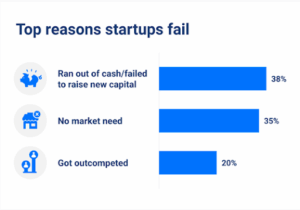
CB insights shows the reason startups fail often
Responding to these signal points early is a smart move, because most businesses that ignore them end up with no business at all a year later. According to CB Insights, even top-performing startups fail due to unresolved cash flow issues.
You need to know the answers to critical questions like:
- What’s your runway?
- What’s burning your cash?
- Which customer segment is truly profitable?
If you can’t answer them clearly, it’s a sign you’re missing the financial clarity your business needs to survive and grow.
How to Find and Hire the Right Fractional CFO
Finding and hiring a fractional CFO doesn’t have to be as complicated as it seems. Start by identifying the experts available, list them out, compare their backgrounds, and review the results they’ve delivered. Most reputable professionals or firms will have case studies or proof of outcomes.
Once you’ve shortlisted the right group of service providers, schedule quick consultations with each one to understand how well they align with your business needs.
If this quick guide still feels too brief, here’s a more detailed breakdown:
1. Find the Right People
Referrals work best. Ask your CA, investor, or peer founders who they’ve worked with and whom they trust.
What doesn’t work? Job boards. Seriously—you’re trusting someone to steer your business finances. You don’t want to be scrolling through job listings for that. Avoid them.
Instead, reach out to founder communities. Connect with like-minded people. Or head over to LinkedIn.
Some CFOs actively share insights and industry updates. Others might stay silent, that doesn’t make them any less capable. Don’t judge by activity alone. Look at their experience. Where have they worked? What stage companies have they served?
2. Match Their Experience to Your Stage
If you’re raising your first ₹5 crore, don’t hire someone who’s only worked with post-IPO firms. And if you’re dealing with operational complexity, don’t bring in a CFO who’s only worked in SaaS.
Make sure their expertise matches your specific problem stage, whether that’s scaling a finance team, fixing unit economics, prepping for investors, or managing cross-entity consolidation.
Ask them: “Which stage of growth do you typically step into? What kind of problems do you solve best?”
-
Use Real Vetting Questions
Skip the bio. Focus on the work.
Ask things like:
- “Can you walk me through a forecast model you’ve built for a founder before?”
- “What risk or compliance blind spots do you often find in companies at our stage?”
- “What’s your approach to fundraising prep, from building the data room to handling investor calls?”
Questions like these reveal how they think, what they’ve actually done, and whether they’ve handled challenges similar to yours.
Wrapping Up
Everything we’ve covered here leads to one point:
When finance starts to affect how fast you move, how clearly you see, or how confidently you make decisions, you need someone who can bring structure without slowing things down.
That’s where fractional CFOs come in.
CFOSME works with founder-led businesses that have outgrown basic accounting, but aren’t yet ready for a full-time CFO. From setting up reporting systems to building investor-ready forecasts, the focus is on helping you operate with clarity.
If you want to understand what that could look like for your business, schedule a quick consultation with our team.
FAQs
1 What is the difference between a fractional CFO and a financial consultant?
A fractional CFO owns financial outcomes – they lead execution, make decisions, and stay accountable for results. Whereas, a financial consultant advises – they deliver recommendations, but don’t usually implement or take ownerships.
2. How can I tell if my business needs a fractional CFO?
If your business is generating over ₹10 crore in revenue (though that’s not mandatory), preparing for fundraising, or dealing with operational complexity across teams, a fractional CFO is likely relevant.
3. Can fractional CFOs help with fundraising?
Yes, fractional CFOs often build investor-grade financial models, prepare data rooms, run diligence simulations, and support founders in aligning projections with valuation narratives.
4. How quickly can they be onboarded?
Fractional CFOs typically start delivering impact within 3–6 weeks, depending on the scope. Initial deliverables often include cash flow visibility, forecast models, and operational controls.
5. Is the relationship legally binding?
Yes, most fractional CFOs operate under professional service agreements, which define the scope of work, duration, confidentiality terms, IP ownership, and exit clauses.